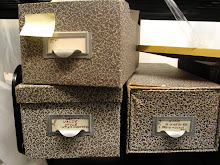
One of the joys of working in an archive is deciphering clues and ascertaining that certain identities are really who they are.
For example, Who is Agent Japonica & Ventriloquist and is there a connection with Meyer Schapiro?
As many of Schapiro's friends, colleagues, and scholars know, he was an adamant supporter of the resistance and the left during the 1930s to the 1950s. For instance, he corresponded with Mark Chirik, a communist revolutionary. There are records that Schapiro was to support Chirik in New York, although the archives never house records that say he in fact did. Several individuals, such as Whittaker Chambers, who defected and later renounced the Communist party, were also friends of Schapiro. Chambers is famously known for testifying before the House Un-American Activities Committee and exposing the likes of Alger Hiss.
Schapiro also had many European friends and colleagues during the wartime, and there are records that indicate he might have known a certain Agent Japonica. Although a certain Blanche Charlet corresponded with Schapiro, none of the letters in the archive directly state she is THE Blanche Charlet who worked with the British Special Operations Executive (SOE) during World War II. Charlet was known as Agent Japonica and Ventriloquist and succedded Virginia Hall in France to spy for the allies against the Germans in Nazi invaded France.
While the political angle may be how Schapiro knew Charlet, it was actually through the art world. Before the war, Blanche Charlet was also a gallery owner and one of the first to represent the surrealist artist Magritte. I couldn't confirm that this Charlet of the art world was also the Charlet of the espionage world until I came across a clue. In a 1978 letter to art critic David Sylvestre regarding Magritte, Charlet writes: "I left Belgium definitely in 1932 for France. During the beginning of the War I discovered I was British becauseg I was born in London. Mobilized in 1941, was trained as a courrier [sic], went back to France, arrested, escaped, came back in 1944, etc..."
Charlet was arrested 1942 by the German occupiers of France and later staged a prison outbreak with other French resistance fighters. Not much is known of Charlet and no definite biography has been written (although Wikipedia cites the publication A Quiet Courage: Women Agents int he French Resistance as a citation for their entry on Charlet). That Wikipedia entry makes no mention of Charlet's role in the artistic community, nor is there any substantial source material about her ( a quick search on Google, World Cat, and a subject heading search on Columbia's library catalog yields nothing substansive if anything at all).
Clues like these all add up to what I call archival archeology: a set of clues laid out within a collection of primary source material that all come together through an amalgamation of archival processing, research, and the hunch that something is more than meets the eye.
All these clues were found in the archives, but did not add to anything until they were pieced together.
Espionage, surrealist art , prison break-outs...all in a days work of an archivist...
Friday, May 29, 2009

Cézanne and Beyond

The well reviewed exhibition Cézanne and Beyond at the Philadelphia Museum of Art closes this weekend. Throughout his life, Meyer Schapiro would write about Cézanne as a man who exemplified the artistic struggle--a struggle that defined the inner pathos of man and his quest to represent that personal journey itself. In a 1959 essay "Cézanne," Schapiro writes:
Cézanne's masterliness includes, besides the control of the canvas in its complexity and novelty, the ordering of his own life an an artist. His art has a unique quality of ripeness and continuous growth. While concentrating on his own problems-problems he had set himself and not taken from a school or leader-he was capable of an astonishing variety. This variety rests on the openness of his sensitive spirit. He admitted to the canvas a great span of perception and mood, greater than that of his Impressionist friends.
Another artist close to Schapiro's reading on Cézanne is Vincent van Gogh. Schapiro's well known rebuttal to Martin Heidegger about van Gogh's boots strikes a similar tone in juxtaposing the artist and his art work with his very own lived experience.
For more information on the Philadelphia exhibit, click here.
Monday, March 9, 2009
Tweezers and shovels : on the use of MPLP
Working on an archival project such as the Meyer Schapiro Papers definitely yields fascinating finds.
In the foreword to the publication Meyer Schapiro Abroad, art historian Thomas Crow notes:
The published writings of Meyer Schapiro, as a contribution to the history of art and human cultural endeavor, would suffice for far more than one distinguished career. But those readers who have found profound inspiration in his texts have invariably been left wishing that he had written at even greater length.
What processing the archive thus far has shown is that Schapiro was in fact a prolific writer, and one with an astounding range of interests in art historical periods, theories, and artists. Many works in the archive feature unpublished essays (or sometimes they are extended research notes that can serve as veritable manuscripts for publication).
Schapiro wrote about naïve art, modern architecture, the
This leads me to question several assertions made about the archival method known as More Product, Less Process.
Within the archival community, the methodology known as More Product, Less Process (MPLP) has emerged as a sine qua non to answering the perplexing challenge of making archival collections available for research, study, and dissemination. Indeed, MPLP is now working its way across the archival field, allowing archival managers and processing archivists the professional green light to rethink how archive collections are represented to the public and how that very public interfaces with the archival collections themselves.
While this methodology has certainly gained traction as a viable means to grapple with the amount of backlogged collections that need attention, the methodology nonetheless has, as I suggest, eclipsed the symbolic resonance of collections. What I specifically refer to as the symbolic resonance of archival collections is their unique character as particular collections that form part of a larger institutional or organizational whole.
As plotted out in the 2005 article "More Product, Less Process: Revamping Traditional Archival Processing" by Mark A. Greene and Dennis Meissner in the journal American Archivist, the authors employed a detailed research study to determine how archivists process their collections. They did so in order to determine which actions are slowing down the archival enterprise that shows the public face of the archival profession: namely, accessibility by users to both physical and intellectual components that form an archival collection.
The MPLP approach (occasionally referred to as the Greene-Meissner approach) rethinks, or "revamps" as the authors suggest, traditional methods of archival processing. Before the article was published, traditional convention had it that an archival collection was once made public after a finding aid or collections guide was drafted, physical contents of the archive were arranged to mirror that very description, and that the condition of all materials housed in that particular collection were sound both in terms of their conservation and preservation needs.
This archival convention is the lure of the archive: that each individual item carries with it direct historical, cultural, or evidential significance. As Greene and Meissner succinctly point out, item level processing has undoubtedly caused a major back log at institutions that hold archival collections.
The existing archival culture seems deeply rooted in an implicit belief that every item in twentieth-century collections is so precious that each must be scrutinized for paper clips that might damage a word. Similarly, the culture seems to guard against appraisal decisions that might cast out one interesting document in a twenty-box series of junk.
Through their research study, Greene and Meissner focused on the following five areas: Arrangement, Description, Preservation, Policies and Metrics.
A year after the article was published, two case studies from the
Indeed, Greene and Meissner provide working archivists with measured, proficient, and efficient methods by which to control the volume of collections that need to be given due access by potential researchers. But there are several key assumptions that the authors make that should also be given due consideration and be challenged.
Outlining their recommendations for descriptive standards, Greene and Meissner posit the following: “The most important guideline [for levels of description] is always to prefer the acceptable minimum—within and across collections—and make each new situation argue for any additional investment of time and effort.”
The conundrum in the authors' argument is well reflected in the above sentence and one which should be questioned: if MPLP is a methodology used for alleviating backlogged collections, how can the method itself be used across collections within a given institution and when does this vector of using MPLP begin or end?
If the heart of an archival institution is their collections, how can a blanket assertion that using only one type of methodology be plausible, given that collections can be used to leverage support from the community, stakeholders, and funding agencies?
Indeed, given our economic times, promoting the use of archival collections is as important as highlighting the individual treasures that they also house. Rather than diving directly into using MPLP as the only approach to managing archival collections, archivists should be stepping back and strategically scrutinizing all collections and identifying which ones can yield public attention and funding.
This is the case with the Schapiro project, a collection that has already elicited interest by researchers and scholars for shedding light on Schapiro’s role in defining a particular type of art historical scholarship.
Greene and Meissner are quick to point out that archival repositories have “become so comfortable with arguing our uniqueness as a program and a repository that we have utterly failed to come to grips with a critical administrative reality [archival processing], a reality that eats 90 percent of our direct program expenditures.”
Backlog is an epidemic in many archival institutions, but MPLP as a methodology should be one tool in an archivist’s larger toolkit. Processing should follow a tiered approach that confronts backlog with a much more nuanced look into which collections can resonate and promote scholarship. Collection surveys to clarify, define, and enumerate on the strengths of archival repository holdings should be initiated prior to adopting MPLP across all collections.
The authors' argument that item level processing and description is a fossil of an archival past is complicated by their own admonition of the failure in forgetting about item level processing and description. The MPLP approach can become an acute problem for those dealing with digital files that are by their nature individual files themselves.
Speaking on the use of MPLP within collections that are either digital or would like to be converted from analog to digital, the authors argue the following:
If arrangement and description of the analog material depend on an initial assessment of the value (or intellectual quality) of the collection in the first place, then finely processed collections will by definition be good candidates for digitization and require less additional descriptive work.
A few sentences later, they also posit: "Retrospectively, the decision to digitize all or part of a collection by definition makes the collection a candidate for improved analog processing."
Throughout the article, the authors are quick to claim that MPLP is the methodology by which to measure how collections should be processed, granting only limited reflection on the cases of those collections that need special care.
As they state:
We are not arguing that some exceptional collections do not deserve more meticulous—even item-level—processing. Nor are we suggesting that it is inappropriate for external granting agencies to fund such intensive and costly work. But we do expect that any project that seeks funding for that sort of work must justify that need against the recommendations made in this study and, perhaps more importantly, that the grantor and the applicant must have a basis on which to calculate the real cost differentials imposed by that more intensive level of work.
But if MPLP should be the bar none of archival processing methodology by which all processing should be justified against, how are collections going to be understood as a whole for a particular institution and what are the conditions under which they will be used to attract the public?
While it can be argued that using MPLP will provide data to further identify which collections to finely process, we should question what all that data will yield if the archival compass points to MPLP as the ultimate destination: in terms of physical as well as intellectual output.
If the representation of archival collections is guided through MPLP, the next step would naturally lead to the question of what is next. And, indeed, continued work on MPLP without reflection on cultivating other collections at finer level leads to an interesting question of why MPLP and finer processing can’t work in tandem.
When the authors assert that “good processing is done with a shovel, not with tweezers,” one should ask: why not at the same time?
The cultural resonance of archival holdings is their diverse texture in underlining the importance of primary source material that an institution holds. We can't snub content for the sake of metrics.
Proper planning by conducting collections surveys, assessing institutional missions, and understanding user expectations can lead to leveraging collections to their fullest in order to promote an archival repository.
These actions celebrate content as much as metrics, a distinction we archivists should remember.
Tuesday, March 3, 2009
Allen Ginsberg and Howl

Allen Ginsberg, poet, activist, and spiritual seeker, attended Columbia alongside Jack Kerouac, who met each other through mutual friend Lucien Carr. Kerouac, at that point, had left Columbia earlier. William Burroughs came into the fray as well, joining the group of friends in New York City.
Columbia celebrates Ginsberg with the annual Columbia HOWL, a celebration of the Beat generation's birth at Columbia University and Ginsberg's continued legacy in the arts.
 While at Columbia, Ginsberg took classes with Meyer Schapiro and continued correspondence with him after his school days at Columbia. Writing to Schapiro in the 1950s as a "Yeoman Storekeeper" from San Francisco, Ginsburg would say this about his artistic pursuits:
There has been a great deal of semi-organized (i.e. drunken excited readings) poetry activity out here which I bet will have national repercussions in maybe a year. Subterranean repr. if nothing else. Jack Kerouac's out here too, going up to Wash. State to sit in povery on Desolation Peak as a fire watcher all summer, Cascade mts. He's like a Mitya gone silent & calm.If semi-organized means drunken excited readings, I wonder what an un-organized reading looked like? Hmm...that's for another day.
In the meantime, you could probably get a better sense of mind altering poetry readings if you use one of William S. Burroughs' Dream Machines, a flicker device that induces the viewer into another state of mind.
While you probably can't officially use the Dream Machine for that purpose here at the RBML, you can certainly view one. The library holds one in the collection and you can read more about it here at the Curator's Choice blog.
Tuesday, February 10, 2009
About that banner image and an introduction...

Welcome to "On Archiving Schapiro," a blog that will follow the course of the project dedicated to archiving the collection of renowned art historian Meyer Schapiro (1904-1996). Throughout the course of the project, I'll be sharing information and findings (some directly related to the archives and Meyer Schapiro and others tangential to, but in the orbit of, Schapiro).
During my first week of gaining initial control of the physical material in the archives, I happened to stumble on a file folder that contained detailed notes and drawings of manuscripts Professor Schapiro had researched during trips to Europe. This one in particular is from the Bibliothèque nationale de France in Paris and is, following Schapiro's file label, from the region of Burgundy.
Schapiro would take very detailed notes on illuminated manuscripts that he viewed across Europe, sometimes copying entire pages by hand. I've attached the image from which the banner image comes.
The banner image is also emblematic of the blog itself. Like the image, with its component parts clearly differentiated to examine its unified whole, this blog will highlight unique aspects of the archival project that will culminate with the collection being fully described, encoded, and accessible.
I hope you'll join me during the course of this project to add insight or comment. In the spirit of Schapiro, I invite you to see how this project will evolve. If you've known Schapiro, as colleague, teacher, friend, or art historian, please share your experiences. As Schapiro once wrote in the essay "On Perfection, Coherence, and Unity of Form and Content,"
Critical seeing, aware of the incompleteness of perception, is explorative and dwells on details as well as on the large aspects that we call the whole. It takes into account others' seeing; it is a collective and cooperative seeing and welcomes comparison of different perceptions and judgments. It also knows moments of sudden revelation and intense experience of unity and completeness which are shared in others' scrutiny.Your collective participation and cooperation will be invaluable to this blog as a forum on Schapiro's work and how it manifests in his archive.
More soon,
Farris
Subscribe to:
Posts (Atom)